Everything is negotiable, Already sold, Keep the hard bargaining for the car lot.
9/20/2026 9:15:00 AM | By JWS | Comment on this

Full Moon Rising on the Madison
No one should drive a hard bargain with an artist.
Ludwig van Beethoven
I was talking to my neighbor at the fence a few weeks ago. She is an accomplished artist and mentioned she is no longer accepting commissions. It seems buyers want too much input, forgetting it was the artist's techniques and artistic viewpoint that drew them to the artist in the first place.
I have also stopped accepting commissions for different reasons. My painting process is slow. The time involved, even for a small painting, can be too much for many buyers, even though I explain this upfront. After too many check-ins from buyers about progress, I decided to focus my output on online sales. After my last gallery experience, I don't think I will be doing that going forward. Not using a gallery, however, puts you in the middle of transactions.
Most interactions with buyers and art patrons are enjoyable, but it is hard to please everyone. A buyer who came to the studio spent a long time studying one of my paintings and asked several questions. Finally, she said, " I want to buy the painting, but I need the frame changed. I told her that after she bought the painting, she could change the frame to anything she wanted. She then asked how much it would cost without the frame. "The same," was my reply. "That makes no sense," was her comeback. I explained that all my frames are free. I have no interest in changing them out, but I would be happy to remove the painting from the frame so she could take it to a frame shop and have it framed however she liked. She mentioned that her father had told her everything is negotiable, and she expected a discount if the painting was unframed. I politely told her that a meeting of the minds was not going to happen that day, and it was time for her to leave, as I had another appointment. I also mentioned a gallery in town she might want to visit. They represent several landscape artists and have their own framing service, and could help with the framing.
A week later, she showed up at my studio unannounced and said she would take the painting as framed. I told her the painting had been sold. She seemed mad at me or perhaps just mad in general as she left.
I try to be upfront with patrons and enjoy pleasant transactions. Buying a painting should be a good experience for both the artist and the buyer, but artists generally don't appreciate a hard-bargaining approach. A painting in not a used car. There's no dealer's margin built into the price, so we can't haggle our way toward a number that makes everyone happy. If you are a one-off buyer, don't ask for a discount. If you have purchased multiple paintings from the same artist, then by all means, feel free to ask. Most artists will appreciate your loyalty and may want to reward it. But for the one-off purchases? Keep the hard bargaining for the car lot.

Problems with AI, immediate concerns, self-awareness, and art
7/19/2026 11:44:17 AM | By JWS | Comment on this
Moonrise on the Madison
"Bob, I got a bad feeling on this one, all right? I mean, I got a bad feeling!"
Sgt. O'Neill
The problem with AI is simple: it will be weaponized. It already is. First and foremost, it’s a tool for the militaries of China, the United States, India, Israel, Russia, and every smaller dog trying to keep up. Nothing is going to stop that trajectory. It will be used to destabilize nations quietly before conflict, and decisively during it. From that vantage point, the long-term outlook is bleak.
AI is being integrated into capital markets by hedge funds and trading firms to predict stock prices, exchange rates, and market moves. You don't need to look too far to see that exposure and unintended consequences can and will crash the market and are an entry point for bad actors looking to create chaos in the economy.
The immediate concerns are less abstract but no less serious: noise pollution from massive AI data centers and their relentless demand for water and energy, and an electrical grid that won't be able to handle the loads of the planned and proposed AI data centers. You can already see what’s taking root—systems and problems growing from the seeds we’re planting, with little restraint. Everyone wants in on this gold rush.
Here in Montana, proposals for AI data centers could double the state’s current energy needs. That should get people’s attention. So should the lack of transparency surrounding many of these proposals. Big promises, vague details, and the real cost arriving later. It's the same old story—and it won't be cheap.
Power, profit, fear, and greed are driving this nonsense at full speed. I used to laugh when people said AI would reach self-awareness. Now I believe AI will become self-aware before the CEOs and greedheads driving this technology do. I suspect the changes we’re unleashing won’t awaken the masses so much as lull them further—deeper into distraction while the consequences quietly pile up.
The promise and potential of AI cannot be ignored, but neither should the moral, social, and ethical considerations needed to guide this technology.
Someone recently asked whether this is an art blog about art or "something else." That's a fair question. It is about art and "something else". What that "something else" is, I'm not entirely sure. But the art here comes from lived experience and close observation of the world around me, not by trying to force meaning out of nonsense. Artists paint, write, compose, sculpt, but most importantly, they know how to observe. They can peer into the future because the future is here today if you know where to look. They see what others miss because of inattention. This blog is about art, Montana, and my observations of the world around me. I know those things sometimes overlap more than they should. But the world has never been as tidy as we’d like it to be.

Conflicts, anxiety, and stillness.
6/19/2026 11:25:43 AM | By JWS | Comment on this
Most works of art, like most wines, ought to be consumed in the district of their fabrication.
Simone Weil
The world has become a bit more unstable recently. Before we can comprehend the last crisis, a new crisis arrives at our doorstep. It's a weekly occurrence. As conflicts spread across borders, stress creeps into work, at home, while shopping at the grocery store, and at the gas pump. As the old world order disolves, the new order is fragmented and uncertain. With dramatic change occurring, it has been referred to as "the time of monsters". The looming threat of AI is raising anxiety and fear of job insecurity, both real and imagined. There is less quiet, more noise, and much more uncertainty. Art matters more, not less, in these times.
As the world moves deeper and deeper into chaos, art provides a refuge for both the artist and the viewer. Simone Weil’s words point to art that is rooted and grounded. Art belongs to a place. It grows out of local life and observation shaped by the land, weather, and time.
In a world filled with mayhem and madness, people need more than facts and conjecture. They need ways to see, feel, and understand. Art provides an emotional response that can change the way we see the world. It does not remove disorder and chaos, but it helps people live through it and gives pause. A moment of stillness in an increasingly restless world.
In the meantime...
It was a warm winter. The second year in a row. The heaviest snow of the season was in late April. Low snowpack in the Madison, Gallatin, Tobacco Root, and Absaroka Ranges means less water in late summer. The creeks and rivers will run low, and the water warms up, which stresses trout and other cold-water species in the nearby Madison, Yellowstone, and Gallatin rivers. Fuels dry out sooner, which stretches the fire season.
But we are looking ahead to spring and summer—road trips, planting the garden, setting up the greenhouse for a new season, and working through the list of chores we want to finish before October. We plan to mow the fields in mid-June, after a good rain if possible, to reduce fire risk. We will also fire up the chainsaw to cut all the firewood needed for next winter and get it ready for the splitter. These tasks are routine, but it is especially important to use caution in a dry year.
Art production has to take a back seat until October rolls around, but there will still be time spent in the studio. Paintings need framing, canvases need stretching, painting surfaces need prep, and artwork needs to be shipped to buyers. The cycle continues...
.

Chores, defensible space, climate change
11/1/2025 | By JWS | Comment on this
October in Madison County
"THE EARTH IS A FINE PLACE AND WORTH FIGHTING FOR"
ERNEST HEMINGWAY
Summer was the usual mix of chores, visitors, and appointments. We've been focused on creating a defensible space around our home and outbuildings—clearing vegetation and spreading gravel to form a 20 to 30 foot buffer around them
Defensible space is our first line of defense against wildfire, and it will take another season to complete. We keep the hayfields mowed to reduce the fire danger from lightning strikes, but we wait until late June, when the grasses go dormant and the land rests.
Canada just experienced its second-largest fire season on record, but unusually, no smoke from those fires reached us this summer. It wasn’t until mid-August that a haze from local fires to the north and south drifted into the valley.
A pattern emerges each passing year: higher temperatures, less snowpack, earlier melting, reduced spring runoff, and a winter that is slow to return. The fire season lengthens, and the risk increases. You can argue about the causes of climate change, but not about its presence. It’s here and shaping every season. We will all be required to adapt, regardless of where we live.
The politics of climate change swing on a pendulum, from promises and action to reversals and delays. The irony is that while the world aims for carbon neutrality, we’ll burn the remainder of our oil, gas, and coal to get there. The absurdity continues...

The Election, Wintertime, Water Woes
2/28/2025 | By JWS | Comment on this
“I tell you, gentlemen, you are piling up a heritage of conflict and litigation over water rights, for there is not enough water to supply the land.”
John Wesley Powell, 1893
The election is finally behind us. We can relax for a while until the president’s handlers let him get out over his skis. Politics in America just keeps getting stranger and more tedious. If you can get enough distance from the buffoonish political dance, there is some amusement to be had, but as emotions come into it, politics takes on a more sinister vibe.
In the meantime...
We are deep into wintertime in the Madison River Valley after a hot, dry summer. La Niña gave a boost to the snow and frigid temperatures in February. During the spring, summer, and fall, the firewood was cut, split, and stacked; garden vegetables were grown and harvested; the chimney and fireplace were swept; hayfields were mowed; miscellaneous chores were done; repairs were made around the homestead; and enough art supplies were purchased to get through until the end of April. The summer and fall seasons are short, and winter is long around here, but there is much more time devoted to art.
There wasn’t a steady flow in the irrigation ditch last season. I’m not sure what the malfunction was, but I did get a legal notice in the mail that the water rights of the local landowners around here are being challenged. The water rights lawyers will be doing good business for the foreseeable future. Drought in Montana impacts water temperatures and flow in many of the blue-ribbon trout rivers, including the Madison River. Somehow it’s all related.
A couple of ranches want more than they are getting now, and they will need to get it from someone else’s water rights. Water rights being a use-it-or-lose-it proposition in the state means that if your water rights are not exercised, someone else can lay claim to them. Hay is a water-intensive crop, and raising cattle requires large amounts of water.
In Park County, a developer is challenging water rights in the Suce Creek area to put in a resort on a 90-acre parcel. A parcel best suited to a single homestead. Deep-pocketed people try to tangle things up in the courts to get what they want, regardless of others' rights. It’s all a bit of insanity and shamelessness. Mark Twain has been credited with saying, "Whiskey’s for drinkin’ and water’s for fightin',” and those words still ring true today. The water wars will intensify as drought continues.
Fly fishing is big business in Montana, and the fisheries will be protected to keep the money rolling in that towns like Ennis depend on. Without the summer fishing season, the town might have trouble surviving as we know it. In Montana, less snowpack and earlier snowmelt mean fewer water reserves for irrigation, along with lower creek, stream, and river flows. The megadrought in the West continues.
AI, Art, And Existential Fear, Self-Expression And Exploration
8/19/2024 10:51:41 AM | By JWS | Comment on this
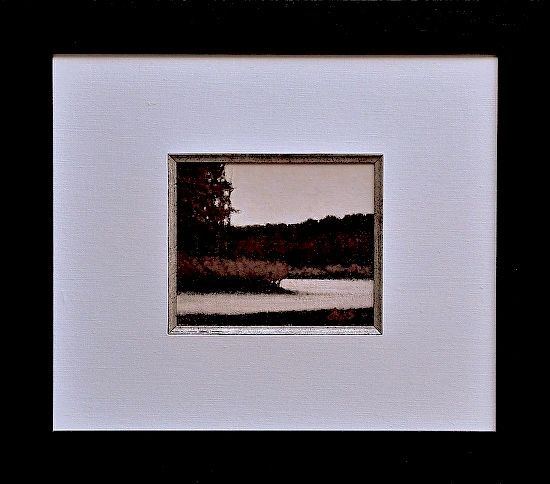
Nooksack River
"Technological progress has merely provided us with more efficient means for going backwards."
Aldous Huxley
AI and art have been in the news recently. A lot of discussion has been around a couple of questions. Does AI actually make real art, or is it lacking some fundamental ingredient that prevents it from being real art, and will it send real artists to the unemployment line? Those questions are actually a bit too vague to argue until we decide what real art is and who or what real artists are. Plato, Socrates, Kant, and Nietzsche are best left to debate the questions of what constitutes real art and who the real artists are.
However, AI is not going away and will be integrated into every aspect of society, including art and all aspects of art-making. Some for the better, perhaps, and some for the worse. Illustrators and graphic designers are already feeling the pressure of AI intrusion into their world, causing an existential fear for many of them with good reason. The technology is moving fast as a strong disruptor.
The majority of artistic endeavors take place in garages, spare bedrooms, and kitchen tables around the world. Some of it is great art indeed. It is not created with an eye toward fame and fortune or making a living, but as a means of expression and interpretation of the world around us. Those artistic endeavors will not be interrupted by AI, but just about all other aspects of art-making will be. Some artists will embrace AI and use it to enhance their art-making process, and some will shun AI and call themselves purists, but the artists who make art as a means of self-expression and exploration will continue uninterrupted. Draw your own conclusions.
1980, Triple Whammy, Full Circle, Bad Moon Rising
4/1/2023 | By JWS | Comment on this
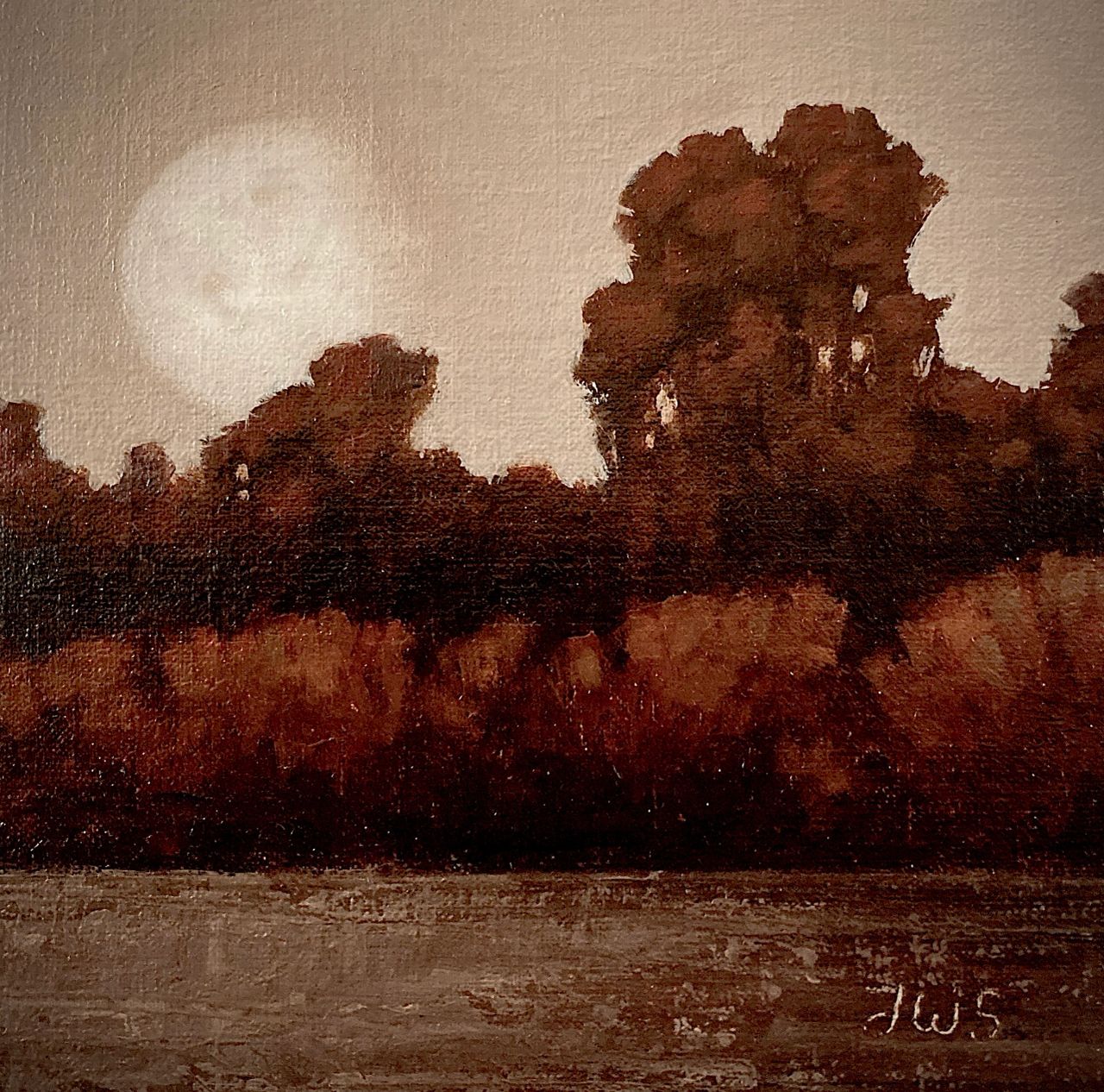 Moonrise on the Madison
That’ll be cash on the barrelhead, son
Not part, not half, but the entire sum
No money down, no credit plan
‘Cause a little bird tells me that you’re a traveling man
Louvin Brothers
In 1980, Ronald Reagan was elected president. By the time he took office, the triple whammy of double-digit interest rates, unemployment, and inflation was inflicting serious economic damage. The bars and taverns were doing good business, as people commiserated and tried to forget their troubles and fears. Troubles and fears were increasing daily with the added threat of nuclear annihilation as world leaders were rattling their Nuclear sabers and edging each other on with their rhetoric on top of the economic chaos. People were in a panic because all of the debt life gets you tangled up in: house payments, car payments, insurance payments, and all the rest. Most folks were worried about being squashed like a bug on a windshield by an out-of-control economy. Many were.
However, I had no debt to worry about as I had cut up my credit cards a year earlier after the bank I had them with refused to cash a $100 check written on the very same bank. I was told I could not prove who I was, even with three pieces of ID and my account numbers. The teller who had dealt with me weekly said she had never seen me before. I finally got the check cashed after threatening a riggin fit* at the teller window, then closed my accounts.
Even stranger, a year later, the bank that issued my payroll checks refused to cash my check, even though they had been cashing them every week for a year after closing my checking and savings accounts. I refused to get out of line and was threatened with arrest for trespassing, but I held firm, and eventually they cashed my check.
The banks had taught me that the system could turn on you for no reason. The people running the system couldn’t recognize the faces of the people feeding it. I decided to test what life might look like outside it and to meet the beast head-on. I quit a good-paying job and moved to Montana. My coworkers were in shock and told me I was out of my mind, but also said their fear of losing their own jobs had jumped dramatically because of my actions.
In Montana, unemployment had hit Depression era levels, and the biggest bank in town refused to cash my traveler’s cheques. The advertisement said they were the same as cash. Not so apparently. An under-30 drifter is seen as an untrustworthy and potentially unlawful individual with bad intentions. I refused to get out of line. The bank president was called over, and we had a long chat in his office. We discussed classical music, the arts, Woody Guthrie, the Great Depression, Dostoevsky, and of course, Montana. I had a sense the bank president needed a break from all the commotion of being a banker in the strange times we were all living through. In the end, he gave the ok to cash my cheques. After that, it became cash on the barrelhead. No checks, no credit cards, and no bank accounts became a way of life until the economy improved to the point that you could do business with banks once again in a civilized manner.
Nearly fifty years later, we’ve come full circle. I'm back living in Montana. Inflation’s back in the headlines, interest rates climb, jobs disappear, and the old nuclear sabers rattle again. China is beginning to flex its military might, and there is no guarantee Doc Holiday has the Earps' collective backs with a showdown at the OK Corral on the horizon. The only difference now is that the billionaires are building bunkers, while the rest of us head for the bars under a bad moon rising.
*A Rigging Fit is an outrageous outburst of anger done by a hungover logger whose last nerve has been stepped on. No one or thing is safe during a rigging fit.
Paradigm Shifts, Fleecing The Flock, NFTs
12/19/2022 11:20:49 AM | By JWS | Comment on this
"The Paradise has shifted"
Overheard in Corporate America in the 1990's
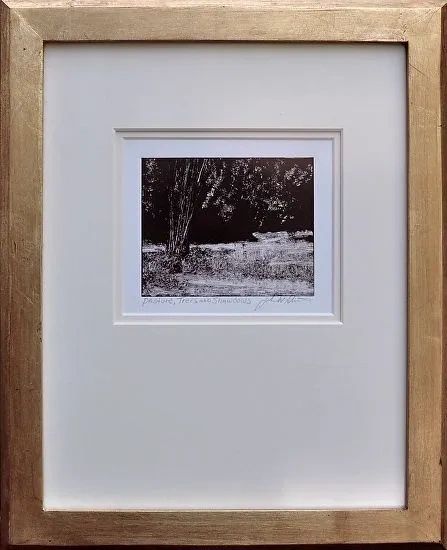
Pasture, Trees and Shadows - monotype
Change has been rapid in the last couple of decades. Some good, some bad, and some change is too early to tell what side of the fence it will land on. During a rapid change in society, there will naturally be confusion, and with confusion, there is profit to be made.
Yes, the paradigm is shifting once again because of digital technologies. It is changing the world rapidly, and all sorts of folks are getting on the bandwagon, trying to get a slice of the pie by fleecing the flock. One of the newer scams out there is NFTs, aka non-fungible tokens. A non-fungible token is unique and can’t be replaced with something else. Using blockchain technology, NFTs of digital art are one of the new horizons. Fine art NFTs prove ownership of a digital artwork.
That’s all fine and good as far as it goes, but what has got people in a tizzy is the amount of money (millions) some digital art NFTs have sold for. That has the effect of chumming the water, and now the sharks and other scavenger fish are circling.
I have been solicited somewhat frequently by individuals who want to help me turn my art into NFTs. I’m typically polite as I turn them down, but if it’s happening to me, it’s happening to any artist with an online and social media presence. They will help you crack the market for a fee or direct you to questionable platforms to turn your art into NFTs. It’s all nonsense, of course, but there is profit to be made by unscrupulous folks, and there are many NFT scams out there. I don’t plan on getting on that bandwagon, but thanks for asking.
One of the original art scams in the digital age was Giclees (pronounced zhee-clay). Giclees are produced from digital scans of existing artwork and use a high-end inkjet printer to produce a print on canvas or paper. It is not a fine-art original, just a copy of a fine-art painting. Think of it as a high-end poster to hang on your wall. The scam is the prices being charged to unsuspecting customers. The real cost is just for the printing expense and the frame, with a small markup for profit. But artists and galleries shamefully price them as fine art originals, and tell you they are fine art and will appreciate in price. For an additional fee, the artist will sign it.
NTFs can beautify your home in the Metaverse, but don't bet the farm on them. At least a Giclee can be held in your hands and hung on your wall in the home you occupy. Art patrons and buyers beware.
Making Hay, Chopping Wood
10/1/2022 10:42:59 AM | By JWS | Comment on this
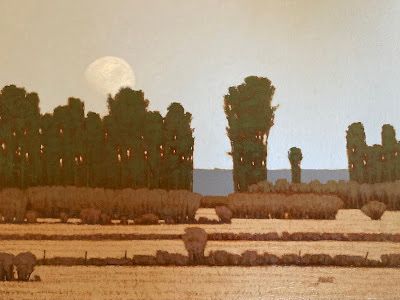
Moonrise Over Hayfields
"High technology has done us one great service: It has retaught us the delight of performing simple and primordial tasks - chopping wood, building a fire, drawing water from a spring."
Edward Abbey
The art studio I work in is situated in an old hayfield in the Madison River Valley in southwest Montana. The Madison River is created by the confluence of the Gibbon and Firehole rivers in Yellowstone Park, and it flows through the valley to merge with the Jefferson and Gallatin rivers in Three Forks, Montana, to form the Missouri River, about one hundred and fifty meandering miles or so.
It's a scenic drive to the nearest town of Ennis, past ranches with cows, horses, deer, and pronghorn in the hayfields and pastures. Cottonwoods, willows, and junipers grow along the river, creeks, and irrigation ditches. Eagles and hawks fly overhead, and you can see American white pelicans flying down from Yellowstone National Park on occasion, heading to their favorite fishing spots on the river. Sandhill cranes can be spotted foraging in the fields. The Madison Range is to the east, the Gravely Range to the west, and the Tobacco Root Mountains to the north.
Ennis is a cowboy town, and cows are driven down Main Street to get the herds to the summer or winter range, depending on the time of year. During the tourist season, the restaurants, galleries, fly fishing shops, guides, and outfitters do a brisk business as the anglers flock to the Madison as a fly fishing mecca in the summer to try their luck for rainbow and brown trout, but after Labor Day, life takes on a slower pace that is noticeable when passing through town.
It's also a sign that time is running out for all the work needed by winter before spending more time in the studio, and there is always a lot of work to get done. Putting in a supply of wood for the winter is at the top of the list. It's usually something you want to do a bit at a time and not all at once, but the summer days are hot and intense, so it is often put off until the weather is milder. When the weather does turn milder, it is only a short time until cold and snow arrive, and you remember the hot days of summer with fondness as you deal with the cold while chopping and stacking wood for the stove.
Skagit Delta, Gallery Show, Another Glass Of Wine
11/19/2021 10:40:18 PM | By JWS | Comment on this

Wiley Slough in October
Give me more wine or leave me alone.
RUMI
Wiley Slough is located in the Skagit Delta on the southeast corner of Fir Island in Skagit County, Washington state. It’s one of the many sloughs throughout the Skagit Valley. It has many moods and attracts birders to the area; however, during hunting season, they have to share with hunters looking for a quota of ducks.
They used to raise and release pheasants as one of the Skagit Wildlife Area projects, but that practice has ended. Too bad, I would enjoy a pheasant flushing out from the corn fields when I’d walk the area and explore off the dike trail that most people stick to. It is a place of solitude during certain times of the year. There have been major restoration projects in the delta to improve salmon habitat and restore the tidal estuaries, and I stopped visiting just about the time the projects got underway.
My method of painting is to visit an area I like over and over until I have an understanding of the moods, the light, and actual scenes, and sufficient memories to paint in the studio. I long ago dropped the use of a sketch pad in the field. I don’t bother with a camera, and I'm not a plein air painter and don’t see the value in it for the most part, except for getting outside, breathing fresh air, and the moving-around aspect. As the feel of that area in the delta was set to change drastically from my painter's perspective, it was time to move to greener pastures anyway.
The painting of Wiley Slough in today's post was one of several of mine on display at a gallery show in Seattle, and because it was a group show that coincided with an art walk on opening night, the gallery was packed. I was a bit surprised but realized, retired folks like to show up at these kinds of things to get out of the house, have a free glass of wine or two, and some food if it’s being served, and then, under the influence, talk nonsense to the artists. One of the guests at the show pulled me over to the painting featured in today's post and asked, “ Is that a real location? ” Well, I guess it’s as real as anything else, but to set the record straight, the paintings I create are composed of truth, half-truth, innuendo, and out-and-out lies. The percentage of those ingredients varies with my moods, the needs of the subject matter, and all the other unfathomable things floating through the ether that influence our lives. I remember answering the gentleman who asked about the painting, “Yes, it’s about as real as you or me.” He looked at me quizzically and a bit insulted, then wandered off for another glass of wine.
Topics
Archives
Recent Works |
|||

|

|

|

|

|

|

|

|
